
If you've come across ads for collagen, you've probably heard something like this: „Marine collagen is incomparably better than bovine" or the opposite – „Only bovine is real collagen." Sounds convincing, doesn't it? The problem is that both claims are incomplete. And incomplete information in the world of supplements can make you spend money on something that doesn't fit your needs – or miss out on something that actually works.
What you'll learn from this article:
- What the real difference between marine and bovine collagen is – molecules, types, origin
- Why "better absorption" isn't as simple as it looks
- What clinical studies show for both types
- Which type of collagen suits your specific goals
- What to pay attention to when choosing a product – and what to ignore
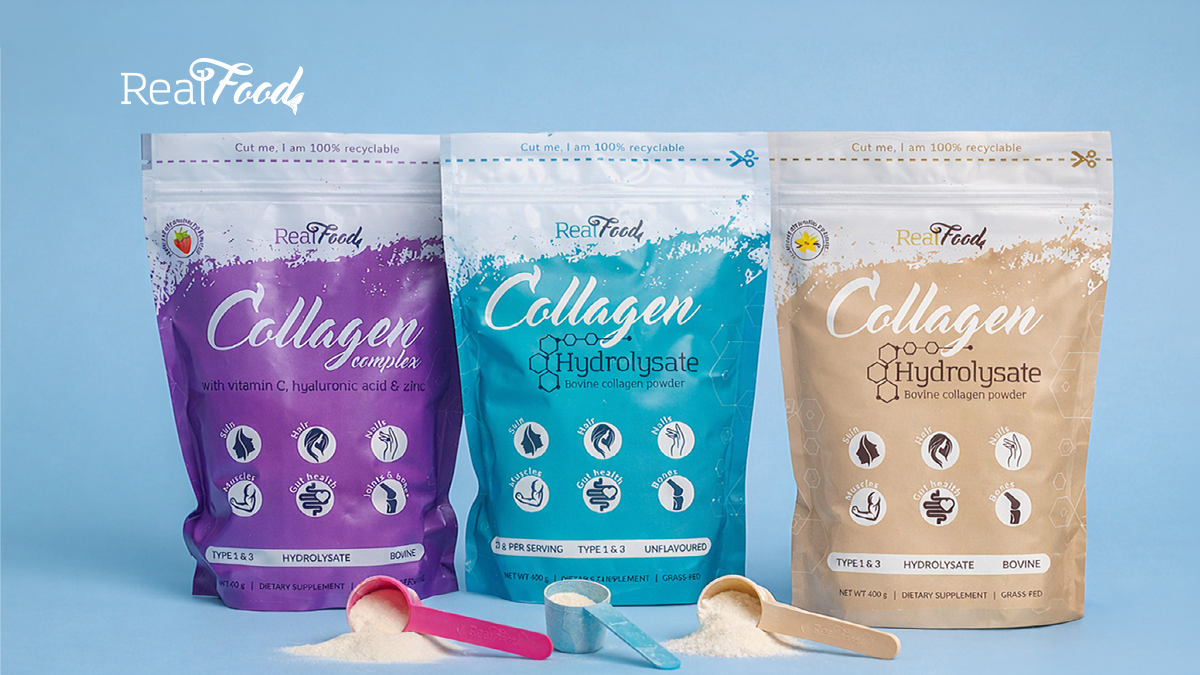
🌟 40,000+ customers drink RealFood collagen every day
„After 30 days my skin changed completely” – Milena, customer
Start your collagen routine with RealFood →✓ Free shipping ✓ Clinically tested ✓ Made in Bulgaria
Where do the two types of collagen come from?
Marine collagen is extracted mainly from the skin, scales, and bones of fish – most often cod, salmon, and tilapia. It's rich in type I collagen (85–90% of its content), just like the collagen in human skin.
Bovine collagen comes from the skin and connective tissues of cattle. It contains type I and type III collagen – the two types critical for skin, joints, muscles, and the intestinal lining.
Both go through hydrolysis – a process in which the molecules are broken down into smaller peptides that the body can absorb. This is exactly where the big difference lies – and it's not in the "type," but in the quality of the processing.
The myth: "Marine is better"
Where does this idea come from? Mainly from molecular weight. Marine collagen has smaller peptide molecules (around 300–500 Daltons compared to the larger ones in bovine collagen), which means it passes through the intestinal wall more easily. Some studies suggest that the absorption of marine collagen can be up to 1.5 times higher than that of bovine collagen – when comparing standard hydrolysates.
But here's the catch: "standard hydrolysates" doesn't mean "every product on the market."
When bovine collagen is processed with advanced hydrolysis technology – such as Peptan® – the difference in absorption evens out significantly. A clinical study with Peptan B (bovine) in 60 women aged 45–60, taking 5 g/day for 90 days, showed:
- a 13% reduction in periorbital wrinkles
- a 10% reduction in nasolabial wrinkles
- a reduced appearance of pores in 57% of participants
Another randomized, double-blind, placebo-controlled study in 120 participants found a +40% improvement in skin elasticity after 90 days of using bioactive collagen peptides.
And the myth in the other direction: "Bovine is better"
Now let's flip the coin. People paying premium prices for "high-quality bovine collagen" simply because it's bovine are just as mistaken. Origin alone doesn't guarantee quality. What matters is whether the raw material is clean, whether the hydrolysis technology is controlled, and whether the peptides have proven bioactivity.
In short: bad bovine collagen will be weaker than good marine collagen – and the reverse is also true.
What you should actually be comparing
Instead of asking "marine or bovine?", ask these questions:

The choice depends on you – here's why
Marine collagen is a good fit if:
- you avoid beef for dietary or religious reasons
- you're after a targeted effect on skin and hydration
- you have a more sensitive digestive system
Bovine collagen is a good fit if:
- you want a broader range of effects – skin, joints, muscles, gut
- you're looking for a proven formula backed by decades of clinical data
- you're allergic to fish or seafood
Both work when they're the right quality. Neither is a cure-all when the quality is poor.
RealFood's collagen: no compromises on quality
Precisely because the difference lies in the technology and purity – not the marketing label – we at RealFood chose Peptan® hydrolyzed collagen of bovine origin – a global leader in collagen peptides with over 30 years of scientific research behind it.
What does this mean in practice?
✔ Low molecular weight peptides for high absorption
✔ Clinically confirmed bioactivity
✔ Clean origin, free of antibiotics and hormones
✔ No added sugars, sweeteners, colorings, or flavorings
✔ Collagen peptides only – nothing else
Because when you buy collagen, you should know exactly what's going into your body.
Recommended by a specialist



What to remember
The marine vs. bovine collagen debate is somewhat relative – it depends on the manufacturer, on the technology. Origin is a starting point, not a final answer.
Focus on the technology, the purity, and the clinical data – and you'll make an informed choice. That's exactly the principle behind RealFood Collagen.
Frequently Asked Questions (FAQ)
Is marine collagen better for skin than bovine?
Both contain mostly type I collagen – critical for skin. Marine collagen has slightly smaller peptides, but with properly hydrolyzed bovine collagen (such as Peptan®) the skin results are clinically proven and comparable.
Is it true that marine collagen is absorbed 1.5 times better?
This figure comes from comparisons between standard hydrolysates. With optimized hydrolysis technology, the difference in bioavailability narrows significantly. The quality of the processing matters more than the origin.
Can bovine collagen help with joints?
Yes. Bovine collagen contains type I and type III – both important for joints and connective tissue. Clinical studies show a significant reduction in joint pain and improved mobility with regular intake.
How long do you need to take collagen for it to work?
Most clinical studies report visible results after 8–12 weeks of regular intake. Collagen doesn't work in 3 days – it requires consistency.
Can I take collagen if I'm a vegetarian?
Both marine and bovine collagen are animal products. There is currently no clinically proven plant-based collagen – since plants don't produce collagen at all. There are supplements that stimulate collagen synthesis (vitamin C, lysine), but these are different from directly taking collagen peptides.
Is marine collagen suitable if I'm allergic to fish?
No. If you're allergic to fish and seafood, marine collagen should be avoided. Bovine collagen is a safe alternative.
Sources
- Peptan clinical study – skin beauty and hair strength (Rousselot):
https://www.peptan.com/new-clinical-study-confirms-peptan-efficacy-for-skin-beauty-and-hair-strength/ - Proksch E. et al. – Oral supplementation of specific collagen peptides has beneficial effects on human skin physiology: a double-blind, placebo-controlled study (Skin Pharmacol Physiol, 2014):
https://pubmed.ncbi.nlm.nih.gov/23949208/ - Asserin J. et al. – The effect of oral collagen peptide supplementation on skin moisture and dermal collagen network (J Cosmet Dermatol, 2015):
https://pubmed.ncbi.nlm.nih.gov/26362110/ - Bello A.E., Oesser S. – Collagen hydrolysate for the treatment of osteoarthritis and other joint disorders (Curr Med Res Opin, 2006):
https://pubmed.ncbi.nlm.nih.gov/17076983/ - ScienceDirect – Daily oral supplementation with collagen peptides improves skin elasticity and joint wellbeing (2018):
https://www.sciencedirect.com/science/article/abs/pii/S0271531717311508 - PMC – Review of the effects of collagen treatment in clinical studies:
https://pmc.ncbi.nlm.nih.gov/articles/PMC8620403/ - Kollo Health – Marine Collagen vs Bovine Collagen comparison:
https://kollohealth.com/blogs/news/marine-collagen-vs-bovine-collagen - ClinicalTrials.gov – BECOME Study: Comparative Efficacy of Bovine and Marine Collagen (NCT06603194):
https://clinicaltrials.gov/study/NCT06603194