









Rosita is the only producer in the world of raw liver oil from freshly caught, wild cod. This means it isn't artificially processed. Here is the answer to one of the most frequently asked questions, along with a comparison between the standard procedure used by other large companies and the one used by Rosita.
Many people don't know that the leading major cod liver oil brands go through processing that includes high heat, high pressure, vacuum, solvents, moisture, and chemicals. In some cases, the fragile Omega-3 fatty acids are heated so intensely that trans fats form and remain in the oil. Heavy metals and other contaminants from fish sourced in polluted waters, as well as toxins formed due to improper processing, long-term storage, and exposure to heat and oxygen, must be "removed" from the oil before bottling. These highly refined, technology-driven processing steps are designed to create a cod liver oil that pours easily and is shelf-stable for mass use. But the processing creates additional harmful substances in the product, a result of the high temperature and the addition of solvents.
Every additional step weakens the integrity and nutritional value of the fish oil. Most popular brands are refined to such an extent that the natural vitamin A and vitamin D3 are damaged or completely destroyed.
Get to know, step by step, the processing of cod liver oil based on extensive research. Keep in mind that some steps may differ depending on the manufacturer's technology, may not be mandatory, or may not follow the exact combination listed. For example, some brands don't fortify their fish oil with vitamins, as a result of which it's poor in them.
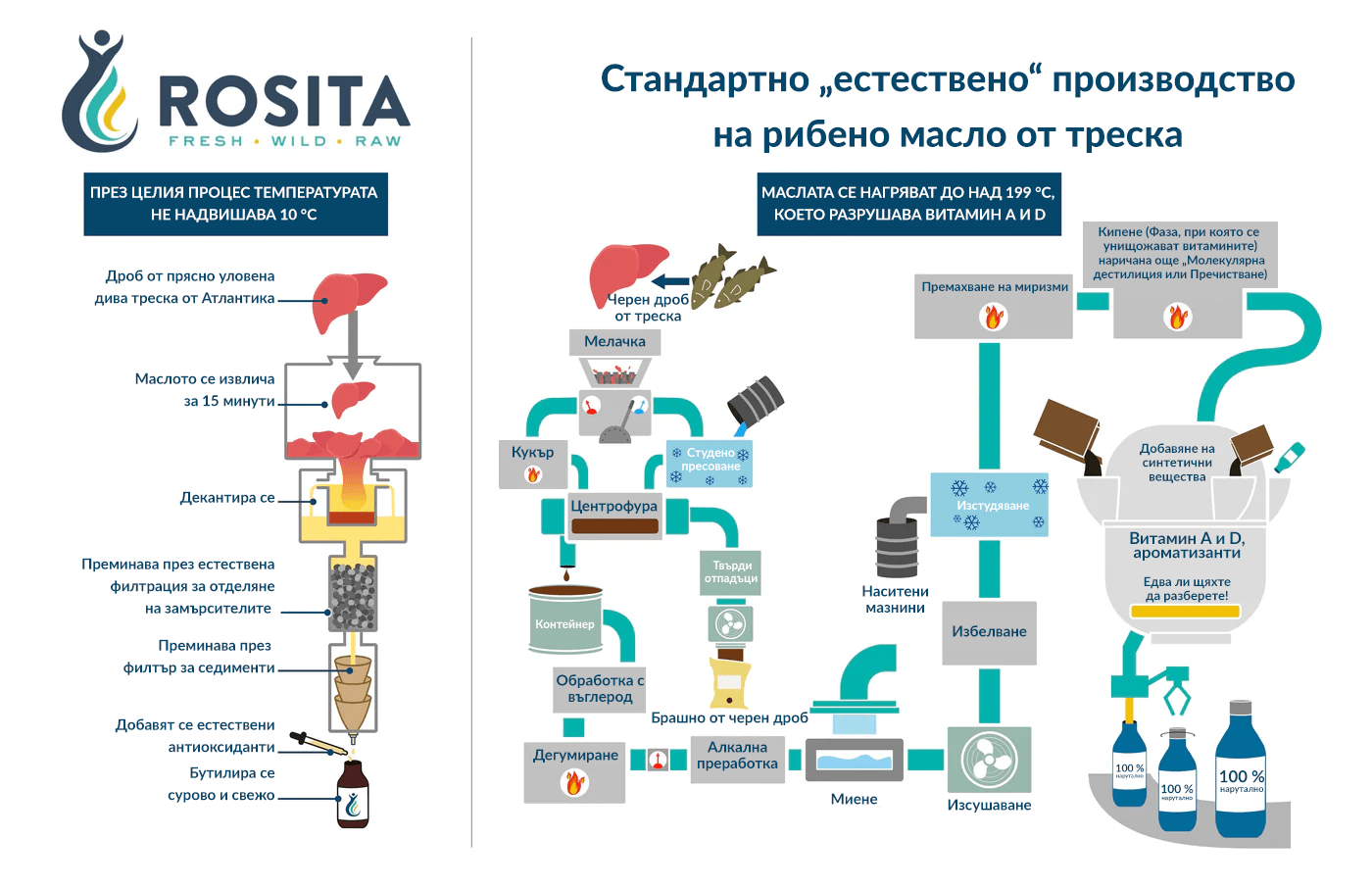
Alkali refining: Removes free fatty acids.
Bleaching: Since cod liver oil quickly loses its freshness, its color - from a beautiful pale gold - turns cloudy. It can even turn brown. Bleaching makes the oil light and clear again.
Winterization (chilling): Removes saturated fats and stearin, which thickens the oil upon freezing.
Deodorization: This is a process in which steam is injected into the oil at low pressure and high temperature, to evaporate the free fatty acids (FFA) and remove the oil's odor.
Molecular distillation: Boiling the oil above 190° C removes pesticides and a large part of its vitamin and nutrient content.
Adding synthetic and „natural“ vitamins: Most fish oil manufacturers add D3 from lanolin to make up for its loss during processing. Lanolin is the fat separated from wool - purified and exposed to ultraviolet radiation. Other companies also add vitamin A for the same reason. But the added synthetic and „natural“ vitamins aren't in the same ratio and synergy as the natural ones found in pure fish oil.
Adding synthetic and/or processed antioxidants: Since natural fish oil doesn't contain enough natural antioxidants, they need to be added. But their quality varies.
Adding synthetic flavors: Artificial flavors such as mint, strawberry, lemon, and others are added to „mask“ the natural odor. So-called natural flavors aren't derived from real forest fruits or herbs, but from ingredients that are considered natural.
Tracing the fish's origin: Depending on the manufacturer, commercial cod liver oil could come from fish that were actually caught in the wild, or it could be extracted from fish of the same species (originating from Alaska and/or Russia). It may also be extracted from fish raised in fish farms. International cod liver oil production is regulated by only one rule — the final product must match the specific ratio of the two main types of Omega 3 fatty acids - EPA/DHA, found in the raw oil, which is 9%:14%. Most often this ratio is 18%:12%. In cheaper brands, fatty acids are added to achieve the required ratio. Regardless of the country of origin, it's bottled and sold as „genuine Norwegian or Arctic cod liver oil“.
Oil extraction process:
- Wild cod is caught by large trawlers – fishing vessels that spend weeks at sea. In the best case, the fish is caught and the liver is collected and transported quickly to the processing plant.The rest of the liver is heated and passed through a decanter to remove solid particles. It's then centrifuged, separating the mass into crude oil, water, and sediment. The crude oil intended for human consumption is processed further, while the residues are dried. These are sold as animal feed.
- In the worst case, the liver is collected and stored on board the ship for long periods, where its quality starts to deteriorate. Upon arrival at the processing facility, the liver is ground and then either heated or cold- and mechanically pressed to extract the oil. Cold pressing refers to extracting the oil from the liver. However, once extracted, the oil is subjected to high heat during degumming (100° C), deodorization (190 °C or higher), and molecular distillation (200 °C).
The idea that cold-pressed liver oil is somehow raw or more gently processed compared to heat processing is a marketing trick.
Carbon treatment: Carbon treatment of the raw oil is done to remove the dioxins, furans, and polyaromatic hydrocarbons, which are toxic. The European Union recommends reducing them in feed and food from farmed fish. If these contaminants appear in wild-caught fish, the cause is pollution of the environment as a whole, and not the specific location. Therefore there's no reason for this processing step to be applied to wild-caught fish from proven clean areas. This stage is part of the processing of farmed fish or fish from areas near industrial zones.
Degumming: The raw oil is hydrated, heated to 100° C, and treated with phosphoric acid to separate out the phospholipids, gums, proteins, minerals, and other substances. The main reason for removing phospholipids is that some of these compounds, especially the calcium and magnesium salt of phosphatidic and lysophosphatidic acids, are strong emulsifiers. If they remain in the oil, particle breakdown can occur during alkali refining/neutralization. Phospholipids interact with water and form insoluble sediments.
Alkali refining or neutralization: Due to the length of time from the fish being caught, through the ship's stay at sea, to the actual processing, triglycerides break down into free fatty acids. This lowers the oil's quality and causes it to brown. This step in the processing is needed to remove these acids, pigments, phospholipids, and insoluble elements.
Water washing: Washing with water and treatment with silicon dioxide remove the „soaps“ created by the alkalis, oxidation products, and other trace metals.
Drying: Removes moisture after washing. Moisture, heat, oxygen, light, and reactive metals additionally have a negative effect on the oil.
Bleaching: The main goal of bleaching is to restore the oil's acceptable pale color, using clay treated with mineral acids. Depending on how long the oil has "aged," up to 2% bleaching clay may be used. Acid-activated bleaching clay also cleans out the hydroperoxides in the oil that formed during the previous steps.
Winterization (chilling): This concentrates the Omega-3 fatty acids. It's addition through subtraction. The oil is chilled to below-freezing temperatures, causing crystallization and a reduction in the amount of saturated fatty acids. Triglycerides and wax are also removed. Removing the saturated fats and triglycerides further destabilizes the oil, since the remaining polyunsaturated fats (in the form of omega-3 fatty acids) are very fragile and oxidize easily. The human body doesn't need concentrated essential fatty acids, especially isolated ones. This reduces the oil's effectiveness.
Deodorization: This aims to remove the remaining free fatty acids, monoglycerides, diglycerides, hydroperoxides, aldehydes, ketones, chlorinated hydrocarbons, volatile compounds, and pigments formed during the previous processing steps. During this process, the oil may be heated to 190°C or higher, as steam is passed through the oil at low pressure. It can lead to the formation of trans fatty acids of EPA and DHA. According to a study of fish oil capsules on the European market, all tested products contained trans fats, amounting to 4.5% of total EPA content and up to 5.9% of DHA content. This step also damages or destroys a large part of the vitamins A and D that are naturally present in fish oil.
Molecular distillation: Molecular distillation removes most of the remaining pesticides and organic contaminants, which include dioxins, lindane, and brominated compounds, and reduces all such environmental pollutants to lower levels. Temperatures can reach 200°C. Sometimes this step is used as a substitute for deodorization. Molecular distillation causes the loss of vitamins A and D, and this also leads to the formation of trans fats.
Synthetic vitamins: Natural vitamin A (retinol) and vitamin D3 (cholecalciferol) are almost entirely removed during the oil's industrial processing. At this stage, most manufacturers add vitamin A from a synthetic source - retinyl palmitate. Synthetic vitamin D3 is obtained from sheep's wool lanolin. It's purified to form 7-dehydrocholesterol, which is irradiated to form D3. Sheep's wool isn't a natural component of cod liver oil.
Besides this, the product may contain additives, colorants, byproducts, and other chemicals produced with the help of crude chemical reagents. Many animal studies show differences in the absorption of synthetic versus natural vitamins. They don't have the same function and effect on the body as natural vitamins found in food, nor do they interact with nutrients in the same way. It's believed that the kidneys have a harder time processing them via urine.
Flavorings: To improve the taste of the oils, companies often add „natural lemon flavor“. Since this can be extracted in natural form from the fruit's peel, the actual formula is patented, and flavor companies don't need to disclose their processes or ingredients (they only certify that the flavoring is free of the eight major allergens). Flavorings aren't organic, and some customers may have a specific reaction due to the citrus content. Other manufacturers use synthetic citrus flavorings obtained by blending patented chemicals.


